The Merry Cemetery
The Merry Cemetery
In Săpânța, in Romanian Maramureș, over 800 blue carved and painted crosses have been telling with humor the lives of villagers since 1935.
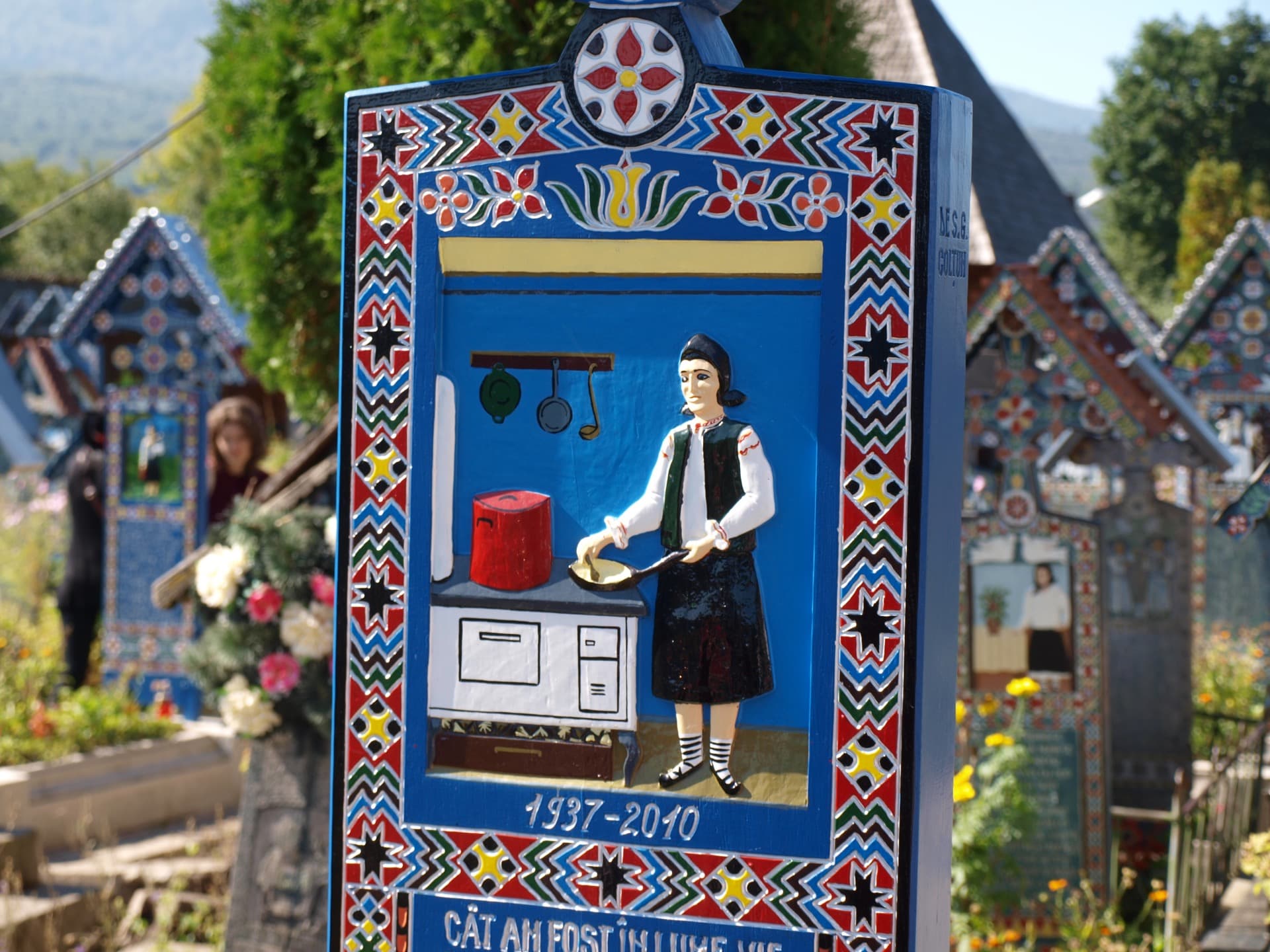
In northern Romania, a few kilometers from the Ukrainian border, the village of Săpânța is home to a cemetery unlike any other. More than eight hundred wooden crosses painted blue tell, through brief versified epitaphs and naïve scenes, the lives of the village's deceased. The Merry Cemetery (Cimitirul Vesel) has become one of the most singular cultural sites in Maramureș and a rare testimony to Romanian folk art.
Why visit the Merry Cemetery
The site is compelling on several counts. From an artistic perspective, each cross combines a painted bas-relief, depicting the deceased's profession or manner of death, with a poem carved in the first person—naïve, often humorous, sometimes biting. From an ethnographic standpoint, the ensemble forms a unique village chronicle, where one reads in images the daily life of rural Maramureș in the twentieth century: woodcutters, shepherds, schoolteachers, peasants, but also road accidents and family tragedies.
The site has been on UNESCO's indicative list of world heritage for several years. Its visit naturally combines with that of the wooden churches of Maramureș, already inscribed on the world heritage list.
A tradition born in 1935
The Merry Cemetery is the creation of sculptor Stan Ioan Pătraș (1908-1977), a local artisan who began in 1935 to paint each cross blue—the blue of Săpânța, a traditional color of hope and freedom—and to carve an epitaph in the form of a brief poem written in the first person, naïve and sometimes ironic.
Pătraș himself carved several hundred crosses during his lifetime. After his death, his apprentice Dumitru Pop Tincu took over the workshop and perpetuated the tradition to this day. The cemetery continues to welcome new crosses, sculpted in the same style and with the same blue tonality, making it a living heritage rather than a frozen museum.
The blue of Săpânța
This deep shade, obtained from pigments prepared according to a local recipe, serves as the common backdrop for all the crosses. It dialogues with the red, yellow, green, and white of the painted scenes, in a palette directly inspired by the traditional costumes of Maramureș.
What to see on site
- The painted crosses: today there are more than eight hundred, arranged around the wooden church of the village. Each bears a figurative scene and a quatrain in Romanian.
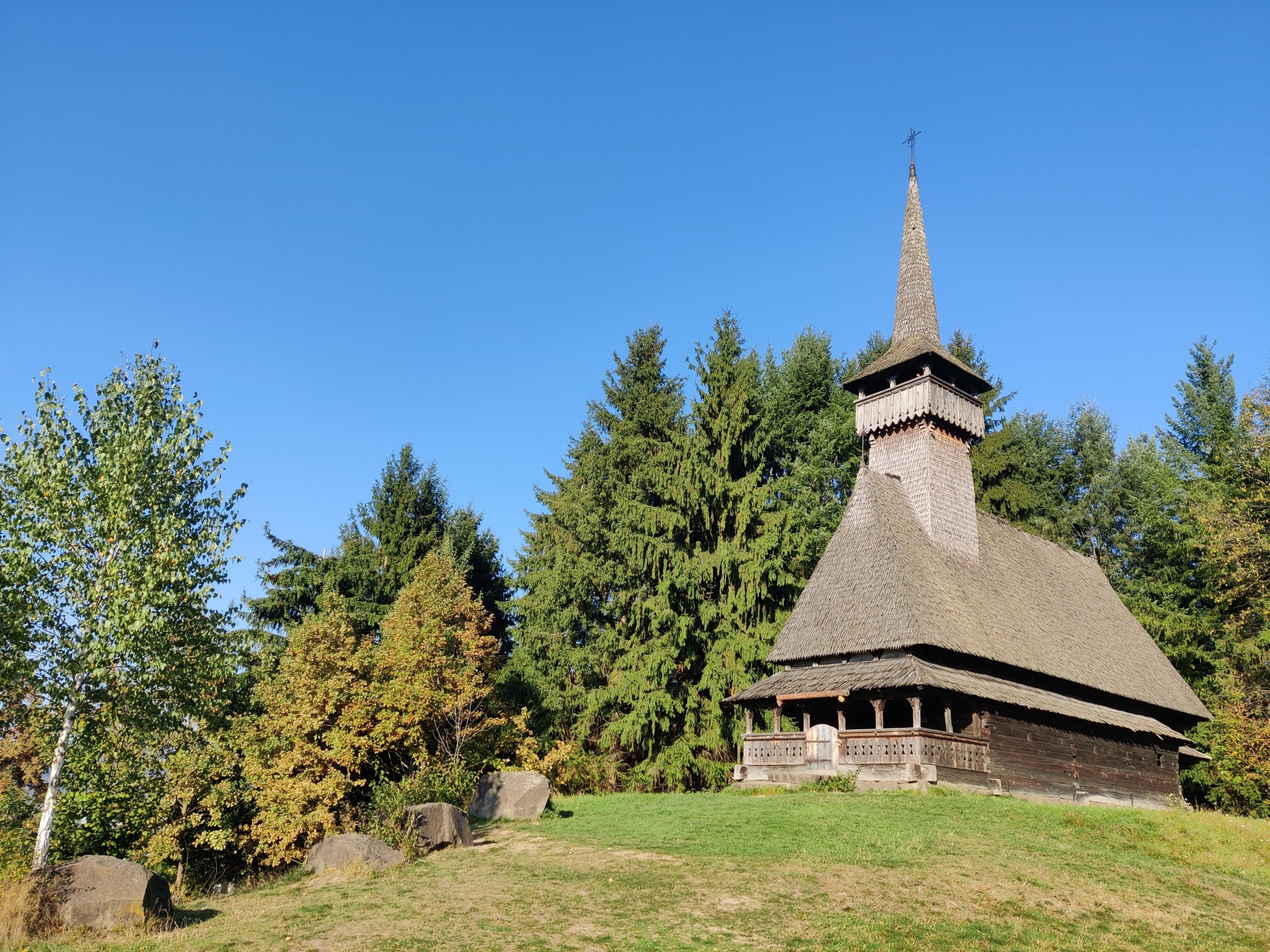
- The wooden church of Săpânța, at the center of the cemetery, modest but characteristic of the wooden religious architecture of Maramureș.
- The epitaphs: take time to ask for a translation or consult a bilingual booklet. Many poems slip in a touch of humor about the deceased's shortcomings—the drunkard, the shrewish mother-in-law, the ladies' man—which makes the singularity of the place.
- The Stan Ioan Pătraș house-museum, a few minutes' walk away. The sculptor's workshop has been transformed into a small museum where one discovers his tools, unfinished crosses, and his own funeral self-portrait.
- The Săpânța-Peri monastery, located at the exit of the village. Its wooden tower stands at approximately 75 meters, making it one of the tallest wooden religious structures in Europe.
Practical information
- Location: village of Săpânța, Maramureș County, approximately 18 km northwest of Sighetu Marmației.
- Duration of visit: allow 1 to 1.5 hours for the cemetery alone, 2 hours including the Pătraș house-museum.
- Fee: modest entry, moderate surcharge for photography.
- Hours: open daily, extended hours in summer, more restricted in winter.
- Accessibility: flat terrain, grass or packed earth paths; comfortable shoes recommended in wet conditions.
When to visit
The most pleasant period runs from May to October. In summer, the light enhances the blue of the crosses and the colors of the paintings, but crowds can be notable in July-August. Spring and early autumn offer a better compromise between pleasant weather and tranquility. In winter, snow covers part of the cemetery and limits the reading of epitaphs, but the visual contrast remains striking for photographers.
How to get there
Săpânța is located on the DN19 road that runs along the country's northern border. From Sighetu Marmației, allow about twenty minutes by car. From Cluj-Napoca, the journey takes approximately 4 hours and 30 minutes by road; from Baia Mare, about 1 hour and 30 minutes. Local minibuses (maxi-taxis) regularly connect Sighet to Săpânța, but a car remains the most flexible solution for exploring Maramureș, whose villages and wooden churches are scattered.
Combine with nearby attractions
Maramureș lends itself to a multi-day itinerary. Nearby, don't miss Bârsana monastery and its wooden ensemble characteristic of the region. To extend your journey toward the south of the country, the Transfăgărășan road crosses the Carpathians, while Corvins Castle offers one of the finest examples of Gothic architecture in Transylvania. Further west, Turda salt mine offers a spectacular underground experience.
Frequently asked questions
Frequently asked questions
The term refers to the tone of the epitaphs, which evoke the deceased with humor, tenderness, or irony, rather than the usual solemnity. This approach reflects a view of the passage to death as a natural stage rather than a tragic one.
More than eight hundred are counted, added progressively since 1935. The tradition continues: new crosses are carved each year in the workshop that succeeded Stan Ioan Pătraș's studio.
Not yet. The Merry Cemetery is on UNESCO's indicative list. The wooden churches of Maramureș, several of which can be visited in neighboring villages, are inscribed on the world heritage list.
The poems are written in Romanian. A local guide or a translation booklet significantly enriches the visit, as the humor and village references are otherwise lost.
Include the Merry Cemetery in your trip
The Merry Cemetery naturally fits into an itinerary in Maramureș and Bucovina, two regions where folk art and wooden religious architecture are discovered as you go through villages. To build a custom itinerary combining Săpânța, painted monasteries, and Transylvania, consult our journeys in Romania.
Interested in this visit?
We can include it in your personalised itinerary.