Histria
Histria
Founded in the 6th century BC by colonists from Milet, Histria preserves thirteen centuries of Greek and Roman remains on the shores of Lake Sinoe.
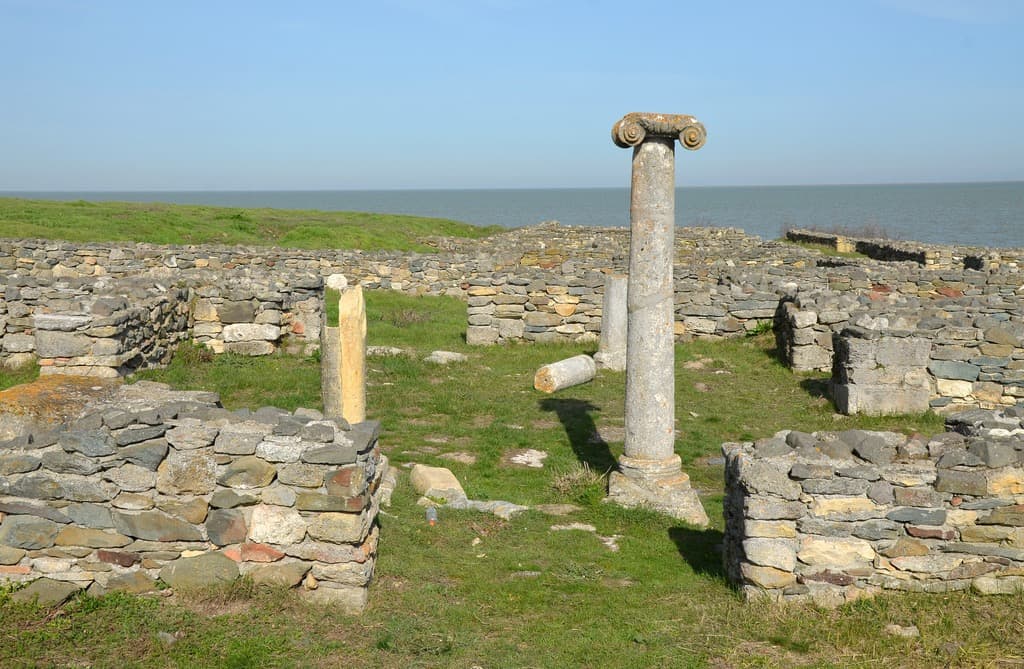
On the coast of the Black Sea, in Constanța county, the archaeological site of Histria preserves the ruins of one of the oldest Greek colonies discovered to date in Romania. Founded in the 6th century BC by colonists from Milet (Greece), the city flourished for thirteen centuries before being abandoned. It stands today on the shores of Lake Sinoe, in a landscape of marshes and steppes typical of Dobrogea.
Why visit Histria?
- A site founded on the shores of Pontus Euxinus (the Black Sea), a direct testament to Greek colonization on the western shore of the Pontus.
- Thirteen centuries of continuous occupation, from the archaic Greek world through to the end of Late Antiquity.
- A rare urban complex in Eastern Europe, featuring Early Christian basilicas, thermal baths, residential quarters and successive defensive walls.
- An on-site museum displaying inscriptions, sculptures, ceramics and coins from excavations.
- A singular natural setting, between the lagoon of Lake Sinoe and the nearby Danube Delta biosphere reserve.
A history spanning thirteen centuries
The Greek foundation
Histria—Istros to the Greeks—was founded in the 6th century BC by colonists from Milet, in Ionia. Like most Milesian trading posts on the Pontus Euxinus, it played a commercial role: exporting grain, salted fish and slaves to the Aegean world, and importing oil, wine and manufactured goods. The city minted its own currency as early as the 5th century BC.
Integration into the Roman world
Captured by the Roman army at the turn of the era, Histria entered the province of Lower Moesia. It retained its Greek civic organization while adopting Roman codes. Excavations have uncovered thermal baths, paved streets and public buildings from this period.
Attacks and decline
The city's history was punctuated by attacks from peoples to the east. To protect itself, no fewer than five successive defensive walls had to be built over time, each shrinking the inhabited space. In the 7th century, invasions and the progressive silting of the Danube estuary spelled the end of the harbor. The site was abandoned and fell into oblivion until the first archaeological excavations undertaken in 1914 by Vasile Pârvan.
What to see on the site?
The successive ramparts
The five lines of fortifications still visible tell the story of the military pressure the city endured. The final enclosure, dated to the end of the Roman Empire, incorporates reused blocks from earlier buildings.
The episcopal quarter
At the center of the site stand the remains of several Early Christian basilicas, including the great episcopal basilica of the 6th century. You can still make out the bases of columns, the baptistery and fragments of flooring.
The baths and forum
The civil sector preserves the foundations of Roman thermal baths and a public square lined with shops. Several residential houses, some equipped with underfloor heating, complete the urban picture.
The site museum
At the entrance to the site, a small museum displays major pieces from the excavations: inscribed grave stelae in Greek, statues of deities, oil lamps, amphorae and coins. A preliminary visit to the museum helps you better interpret the ruins.
Practical information
- Location: Istria commune, Constanța county, approximately 60 km north of Constanța.
- Duration of visit: allow 2 to 3 hours to explore the site and museum.
- Admission: moderate entrance fee, combined ticket for site + museum available.
- Equipment: closed-toe shoes, water, hat and sun protection; the site is open and offers little shade.
- Accessibility: uneven and rocky terrain, not well-suited for strollers or people with reduced mobility.
When to visit Histria?
The best period extends from May to early October. In midsummer, the heat can be intense on the steppe and harsh light makes visiting in the middle of the day challenging: favor the morning or late afternoon. Spring and early autumn offer milder conditions and favorable light for photography. In winter, the site remains accessible but the wind from Lake Sinoe can be biting.
How to get there?
Histria is easily reached from Constanța by the DN22 road, heading towards Tulcea. The journey takes approximately one hour by car. From Bucharest, allow 3 to 4 hours of driving. Public transport serves the site poorly: a rental car or an organized excursion remain the most practical options. The site lends itself well to a stop on an itinerary combining the Black Sea coast and the Danube Delta.
To combine with your visit
Histria fits naturally into a circuit dedicated to Romanian heritage. To extend your cultural exploration of the country, you can pair this site with other remarkable stops:
- Biertan and its fortified Saxon church, in Transylvania.
- The wooden churches of Ieud, jewels of Maramureș.
- The ASTRA Ethnographic Museum in Sibiu, Romania's largest open-air museum.
- The Creasta Cocoșului geological reserve in the Gutâi mountains.
Frequently asked questions
Frequently asked questions
Yes: it is one of the oldest Greek colonies discovered to date in Romania, founded in the 6th century BC by colonists from Milet, on the western shore of the Black Sea.
Allow 2 to 3 hours to explore the museum at the entrance and the archaeological site. Antiquity enthusiasts can spend a half-day here.
Yes. The site is located approximately one hour's drive north of Constanța, making it possible for a half-day excursion from the city.
Five successive defensive walls, Early Christian basilicas, Roman thermal baths, residential quarters and an on-site museum displaying inscriptions, sculptures and coins from excavations.
The terrain is flat but uneven and offers little shade. Children interested in archaeology will enjoy the museum and walking among the ruins, provided you bring water and sun protection.
Include Histria in your Romania trip
The Histria site integrates perfectly into an itinerary combining the Black Sea coast, the Danube Delta and ancient heritage. To build a tailor-made itinerary, explore our Romania tours and connect with our destination specialists.
Interested in this visit?
We can include it in your personalised itinerary.