Bicaz Gorges
Bicaz Gorges
A six-kilometer limestone gorge in the Eastern Carpathians, crossed by the DN12C between vertical walls, the Bicaz River and artisan stalls.
The Bicaz Gorges (Cheile Bicazului) cut through the Eastern Carpathians for roughly six kilometers, between Neamț and Harghita counties in central-eastern Roumanie. The DN12C road winds through between vertical limestone walls that can reach several hundred meters high, while the Bicaz River runs alongside the road. It's one of the country's most spectacular driving routes, often compared to the Transfăgărășan road for mountain driving.
Why visit Bicaz Gorges
The gorges' appeal lies in the rare combination of a tightly compressed mineral passage, a navigable panoramic road suitable for cars, and artisans stationed along the route. The limestone walls frame a narrow road, sometimes reduced to a strip squeezed between cliff and river, creating successive viewpoints without requiring strenuous hiking. For those traveling between Transylvania and Romanian Moldavia, it's a logical itinerary rather than a detour.
Travelers also appreciate the connection with Roșu Lake, located at the western entrance to the gorges, and the chance to encounter artisans selling their wares along the road, notably local pottery with traditional motifs from the Csángós and Szekler regions.
Ancient geological formation
The gorges are carved into Cretaceous limestone of the Hășmaș mountains. The Bicaz and its tributaries have carved through rock for millions of years to create the current gorge, whose narrowest section, nicknamed Gâtul Iadului ("Hell's Throat"), reduces the space to just a few meters between two vertical walls. The entire area is part of Cheile Bicazului-Hășmaș National Park, created to protect this karstic landscape and the endemic flora clinging to the walls.
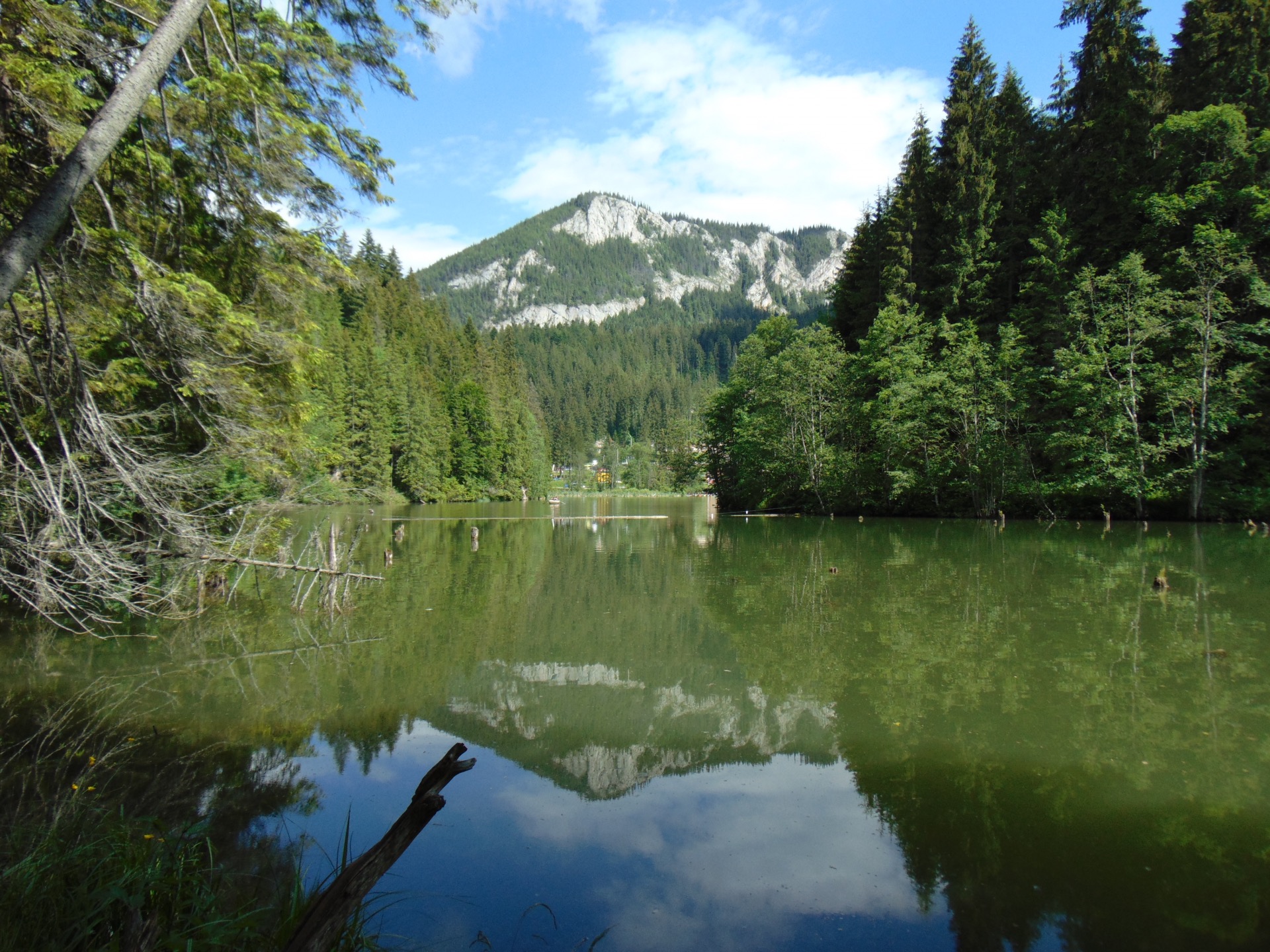
Roșu Lake, its immediate neighbor, formed in 1837 following a landslide that blocked the Bicaz valley. The spruce trunks submerged at that time still emerge from the surface in places, giving the site its characteristic appearance.
What to see and do on-site
Driving through
The main experience is crossing the DN12C between Bicaz Chei and Lacu Roșu. The road has several widened areas designed for stopping, photographing the walls and observing climbers practicing on equipped climbing routes. A few short tunnels punctuate the journey.
Artisan stalls
In the wider sections, artisans set up their stalls: hand-thrown pottery, hand-carved wooden objects, embroidered textiles, sheep's cheese and wild fruit preserves. It's an opportunity to buy directly from producers, keeping in mind that quality varies from stall to stall.
Roșu Lake
At the western end of the gorges, the lake offers boat trips, a partial loop trail and several viewpoints over the Hășmașu Mare massif. Allow 1 to 2 hours to enjoy it at leisure.
Hiking and climbing
Several marked trails depart from the gorges toward the national park, notably toward the Suhardul Mic summit, which offers a plunging view over the gorge. Equipped climbing routes attract a community of Romanian and foreign climbers from May to October.
When to visit
The best period extends from May to October, with long days and clear roads. Summer (July-August) concentrates tourist traffic and artisan stalls are all open at this time. September brings autumn colors on the wooded slopes, with fewer crowds. In winter, the road remains open but can be icy or occasionally closed after heavy snowfall: winter equipment mandatory and caution needed in the narrow sections.
Practical information
- Duration of visit: allow 2 to 3 hours to cross the gorges with stops at viewpoints, a half-day if you combine with Roșu Lake.
- Access: road open year-round, free, no ticketing. The national park may apply a modest fee on certain trails.
- Driving: narrow road, tight curves, sometimes difficult crossings with buses. Avoid peak summer hours in mid-day.
- Parking: informal areas along the road, often occupied in high season.
- To bring: cash in lei for purchases from artisans, closed-toe shoes if you plan to walk off the road.
How to get there
The gorges are crossed via the DN12C, which connects Gheorgheni (to the west, in Transylvania) to Bicaz (to the east, in Romanian Moldavia). From Brașov, allow roughly 3 hours 30 minutes of driving via Miercurea Ciuc and Gheorgheni. From Piatra Neamț, the eastern entrance is about 1 hour away. No train directly serves the gorge: a rental car or car with driver remains the most practical option. Day excursions are also offered from Brașov, Piatra Neamț or Cluj-Napoca.
To combine in the region
- Barsana Monastery, heading up toward Maramureș via Bucovina.
- The Transfăgărășan road, another major mountain axis, further south in the Southern Carpathians.
- Salina Turda, accessible by extending your route toward Cluj.
- Corvin Castle in Hunedoara, for a wider Transylvanian loop.
Preparing your trip
Bicaz Gorges fit naturally into a circuit linking Transylvania to the Bucovina monasteries. To build a bespoke itinerary including this Eastern Carpathian passage, consult our Roumanie journeys.
Nearby
Interested in this visit?
We can include it in your personalised itinerary.