Sarmizegetusa Regia
Sarmizegetusa Regia
Capital of the Dacian kingdom destroyed by Trajan in 106 AD, Sarmizegetusa Regia preserves its sanctuaries and fortifications deep in the Romanian Carpathians, inscribed as a UNESCO World Heritage Site.
Perched at over 1,200 meters altitude in the Orăștie Mountains of southern Transylvania, Sarmizegetusa Regia was the political, military, and religious capital of the Dacian kingdom. This major archaeological site, inscribed as a UNESCO World Heritage Site in 1999, preserves the ruins of a powerful civilization obliterated by Rome in the early 2nd century AD. Far from mainstream tourist routes, it offers a rare glimpse into the pre-Roman history of Central Europe.
Why visit Sarmizegetusa Regia
The site holds a dual appeal: historical and scenic. Historically, it represents the political heart of Dacia, a kingdom that resisted the Roman Empire for nearly two decades. Scenically, the entire complex unfolds within a forest of beeches and firs typical of the southern Carpathians, making the visit contemplative and serene, far removed from crowds.
Sarmizegetusa Regia is one of six Dacian citadels collectively inscribed by UNESCO in 1999, alongside Costești-Cetățuie, Costești-Blidaru, Piatra Roșie, Bănița, and Căpâlna. It stands out from the others through the presence of monumental sanctuaries, including the famous circular sanctuary often compared, by its presumed function, to a solar calendar.
History of the site
Under the reign of King Decebalus (87–106 AD), the ancient city of Sarmizegetusa Regia (in Latin) served as the capital of the Dacians, the northern Thracians, also called Getae by the Greeks. The city housed the royal residence, metallurgical workshops, and the sacred zone where rituals of Dacian religion, still poorly understood, were concentrated.
Roman Emperor Trajan besieged it in 101–102 during his first campaign against Decebalus. The Dacian king managed to negotiate a fragile peace, but confrontation resumed. The Second Dacian-Roman War (105–106) led to Decebalus's defeat; he took his own life rather than fall into Roman hands. Trajan ordered the systematic destruction of the site and founded a new provincial capital further west, Ulpia Traiana Sarmizegetusa, not to be confused with the Dacian city.
The ruins then lay buried beneath forest for nearly sixteen centuries before being rediscovered in modern times. Systematic excavations began in the 20th century and continue today, regularly revealing new insights into Dacian urban planning and construction techniques.
What to see on the site
The fortified citadel
The defensive nucleus occupies the summit of a ridge. The walls, built using the technique known as murus dacicus, alternate dressed limestone blocks with internal filling and horizontal timber beams forming tie-courses. Several sections have been excavated and reveal the sophistication of Dacian military engineering.
The sacred zone
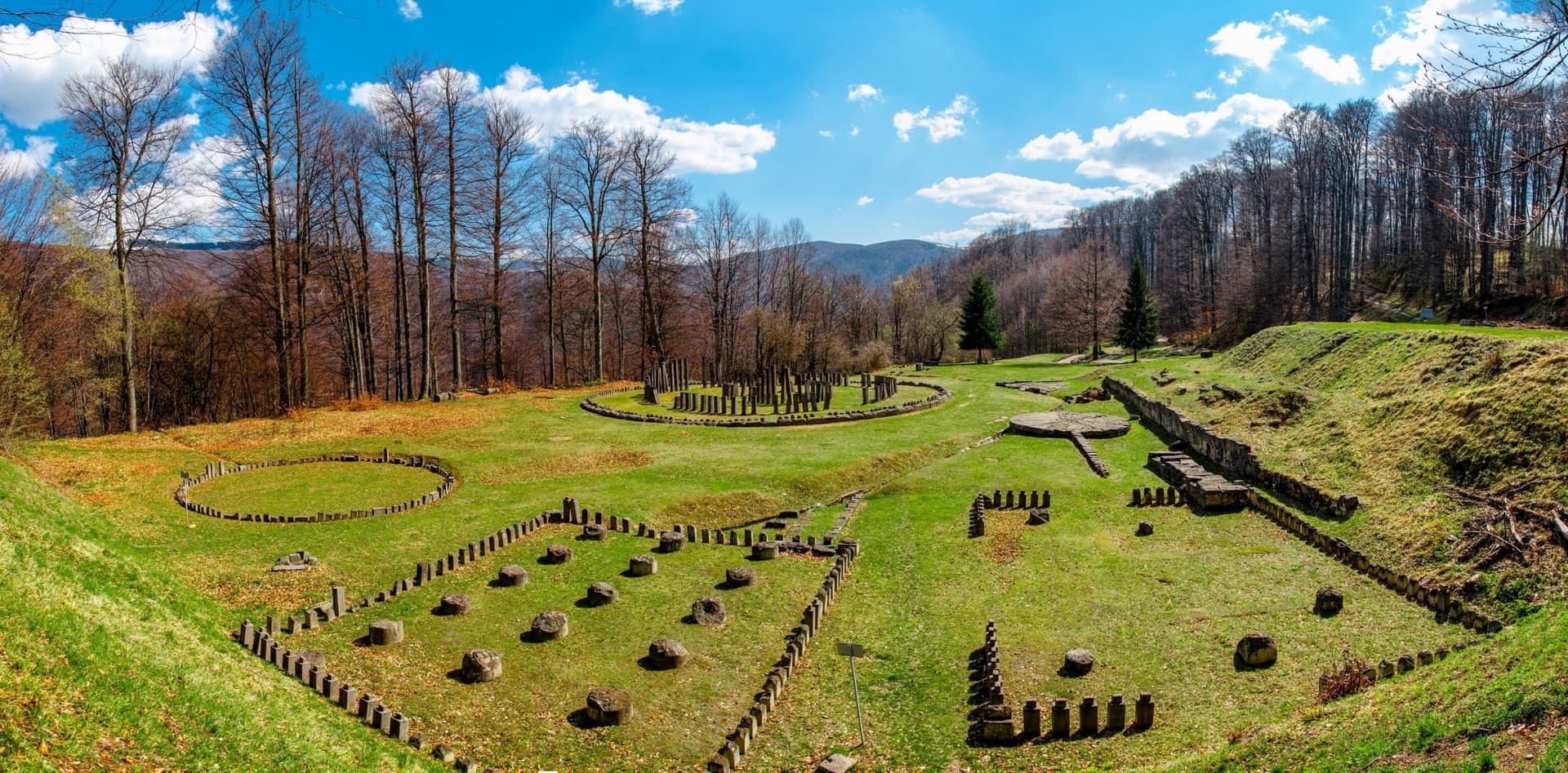
This is the most striking element of the visit. It includes:
- The great circular sanctuary, composed of andesite blocks and vanished wooden elements, whose arrangement suggests an instrument for measuring time;
- The small circular sanctuary, more modest but well preserved;
- Several rectangular sanctuaries whose limestone column bases are aligned with precision;
- The andesite solar disk, a carved slab often interpreted as an altar or ritual calendar.
The civic and craft zones
Surrounding the religious nucleus, terraces carved into the slopes once accommodated dwellings, workshops, and storage facilities. Ceramic drainage channels still visible today testify to the high technical level achieved by the Dacians.
Practical information
The site is open to the public primarily from April to October, with more restricted access in winter due to snow. Tickets are sold at the entrance at a moderate rate. Allow 2 to 3 hours to tour all developed areas at a leisurely pace.
- Wear sturdy hiking shoes: the trails are steep and sometimes muddy after rain.
- The site is deep in forest, with no refreshment stands or restaurants on-site: bring water and snacks.
- Signage is primarily in Romanian; an English-speaking guide or pre-downloaded audio guide is recommended.
- Drones are strictly regulated on this UNESCO site.
When to go
The most favorable period extends from late May through early October. In June and September, visitor numbers remain low and the low-angle light particularly enhances the ruins. In summer, temperatures stay cool thanks to the altitude, making the visit pleasant even during heat waves on the Romanian plains. In autumn, the surrounding beeches turn ochre tones that transform the atmosphere of the sacred site.
Winter is best avoided unless you're an equipped trekker: the access road may close and ruins disappear under snow.
How to get there
Sarmizegetusa Regia is located in Hunedoara County, approximately 40 km south of Orăștie and 25 km from Costești, the last village before the site. From Deva or Hunedoara, allow about 1.5 hours of driving; from Sibiu, about 2.5 hours.
The final approach is via a narrow, winding mountain road, partially paved. A personal vehicle or organized transfer is necessary: no direct public transport exists. A parking area is available at the site entrance, from which a 10- to 15-minute trail leads to the first ruins.
What to combine in the region
Southern Transylvania offers several natural extensions to your visit:
- Biertan, a Saxon fortified church also inscribed as a UNESCO World Heritage Site;
- the ASTRA Ethnographic Museum in Sibiu, one of Europe's largest open-air museums;
- Histria, another major ancient site in the country, on the Black Sea coast;
- the Creasta Cocoșului geological reserve to extend your mountain experience.
Frequently asked questions
Frequently asked questions
No. Sarmizegetusa Regia is the Dacian capital destroyed by Trajan in 106. Ulpia Traiana Sarmizegetusa is the Roman capital founded afterward, located approximately 40 km further west. The two sites are distinct and are visited separately.
Allow 2 to 3 hours on site to tour the citadel and sacred zone. Adding travel time from the nearest town, plan for a full-day excursion.
The site suits children old enough to walk comfortably, but steep and uneven trails make it difficult for strollers and people with reduced mobility.
Yes, the site is freely accessible after purchasing a ticket. However, a guide or supporting documentation beforehand is highly recommended to understand the function of the sanctuaries, which may be unclear to the uninitiated visitor.
Plan your trip
Sarmizegetusa Regia fits perfectly into a Transylvania circuit focused on history, archaeology, and Carpathian landscapes. To build your itinerary and benefit from tailored advice, consult our trips to Romania.
Interested in this visit?
We can include it in your personalised itinerary.