Complete guide to Romania
From our agency in Bucharest, we view Romania as a country of transitions: the Danube plain gives way to the hills of Wallachia, which rise toward the arc of the Carpathians before descending into Transylvania and its fortified Saxon villages. Seven hours of driving separate Bucharest from the painted monasteries of Bucovina, and the same to reach the Danube Delta on the Black Sea side. These distances explain why a stay of less than ten days requires making choices.
The wildlife of the Carpathians remains one of Europe's densest: approximately 6,000 brown bears, wolves, lynx, observable with local guides in the Piatra Craiului or Apuseni Mountains massifs. On the heritage side, the exterior frescoes of the Voroneț and Sucevița monasteries (16th century), the wooden churches of Maramureș, and the seven Saxon citadels listed as UNESCO World Heritage sites around Sibiu and Brașov make up a singular cultural heritage, straddling Romanian Orthodoxy and Germanic influences.
For a first trip, we recommend combining Transylvania and Maramureș over ten to twelve days, or adding Bucovina if you have fifteen days. The Danube Delta and Black Sea coast lend themselves more to a thematic nature-focused stay, in May-June for birdwatching.
The regions of Romania
Each region has its own personality: climate, landscapes, pace of life and ways of traveling. Our local team helps you choose the combination that suits you.
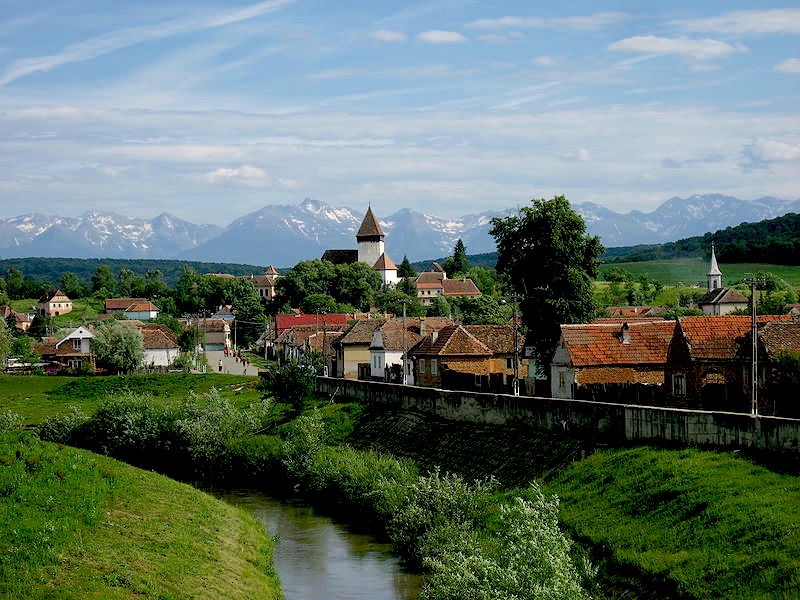
Transylvania
In the heart of the country, Transylvania unfolds a rolling plateau framed by the Carpathians. Brașov, Sibiu and Sighișoara form a triangle where you can travel between them in two to three hours by car. The fortified Saxon villages around Viscri and Biertan can be explored on foot or by bike among wildflower meadows and beech forests. The average altitude is around 500 metres, with mild summers (22-26°C in July) and snowy winters ideal for skiing at Poiana Brașov. This is also where you'll find Bran and Peleș castles, and the hiking massifs of Piatra Craiului and the Făgăraș Mountains.
Maramureș
In the north, Maramureș preserves a rural way of life that surprises visitors. In the Iza and Mara valleys, peasants still harvest by hand and carts cross paths with cars. Eight wooden churches from the 18th century are UNESCO-listed, including those of Bârsana and Ieud, with their 50-meter spires. The Happy Cemetery of Săpânța, with its painted blue crosses and humorous epitaphs, tells a different story about death. Plan for two to three days on site, ideally in June for the hay season or in September for autumn colors. Summer temperatures average around 24 °C.
Bucovine
In the northeast, Bucovine is home to five monasteries with exterior frescoes painted in the 16th century: Voroneț, Sucevița, Moldovița, Humor, and Arbore. The blue of Voroneț, obtained from pigments whose exact composition remains debated, has withstood five centuries of weathering. The monasteries can be visited over two days from Gura Humorului or Suceava. Around them, the wooded hills of the Eastern Carpathians peak at 1,900 meters and offer beautiful hiking in June-July. The region remains one of the most devout in the country, with vibrant Orthodox liturgies in still-active monastic communities.
Carpathians and Prahova Valley
Between Bucharest and Brașov, the Prahova valley opens the gateway to the southern Carpates. Sinaia and its Peleș Castle (a Neo-Renaissance royal residence completed in 1883), Bușteni and the Bucegi massif with its rocky formations of the Sphinx and Babele, Predeal and its ski slopes: the region concentrates mountain activities accessible from the capital in two hours by train. The peaks exceed 2,500 meters at Moldoveanu and Negoiu (Făgăraș massif). This is where we organize brown bear observation outings, at the forest's edge, led by local biologists.
Danube Delta
At its far eastern end, the Danube splits into three branches before reaching the Black Sea, forming 5,800 km² of wetlands classified as a UNESCO World Heritage site. More than 300 bird species nest or pass through here: white and dalmatian pelicans, purple herons, terns. You can navigate these waters by flat-bottomed boat from Tulcea or Crișan, in May-June for nesting season, in September for migrations. The Lipovan villages, descendants of Russian Old Believers settled in the 18th century, still live from fishing. Allow a minimum of three days, staying with local families in Mila 23 or Sfântu Gheorghe.
Bucharest and Wallachia
The capital is home to 2 million inhabitants and an eclectic architectural heritage: the historic Lipscani district, Art Nouveau villas in the Cotroceni neighbourhood, Communist brutalism of the Parliament Palace (the world's second-largest administrative building) and Haussmann-style boulevards that earned the city the nickname Little Paris in the 1930s. Our agency is based here, and we recommend devoting two full days to it. Around it, Wallachia extends to the Danube with the Horezu and Cozia monasteries, and the thermal spa town of Călimănești. Marked continental climate: 30 °C in July, sometimes -10 °C in January.
Explore by theme
Unique experiences tailored to every traveler.
Culture & Heritage
Temples, musées, sites historiques
Nature & Landscapes
Parcs nationaux, montagnes, forêts
Sea & Beaches
Littoral, îles, sports nautiques
Wildlife & Biodiversity
Observation animale, sanctuaires, réserves
Activities & Adventure
Trek, kayak, escalade, sports outdoor
Gastronomy
Cuisine locale, marchés, cours de cuisine
We use cookies to improve your experience and measure our site's audience. You can choose what you accept. Learn more.