The Sphinx and the Babele
The Sphinx and the Babele
On the Bucegi plateau at over 2,200 m, the Sphinx and the Babele are two rock formations sculpted by the wind, accessible by cable car from Bușteni.
On the Bucegi plateau, at over 2,200 metres altitude in the Southern Carpathians, two rock formations capture the attention of hikers: the Sphinx and the Babele. Sculpted by wind, frost and rain over millennia, these mineral silhouettes rank among the most recognisable images of Romania's high mountains, accessible from Bușteni by cable car or via trails through the natural park.
Why visit the Sphinx and the Babele
- Two geological curiosities gathered on the same plateau, just minutes' walk from each other.
- A 360° panorama over the Bucegi massifs, the Prahova valley and, on clear days, the surrounding peaks.
- Quick cable car access from Bușteni, allowing you to reach the plateau without serious hiking.
- A cultural dimension linked to Dacian legends and Romanian mountain lore.
- A hiking terrain that opens onto the entire Bucegi natural park for more experienced walkers.
Geology and cultural heritage
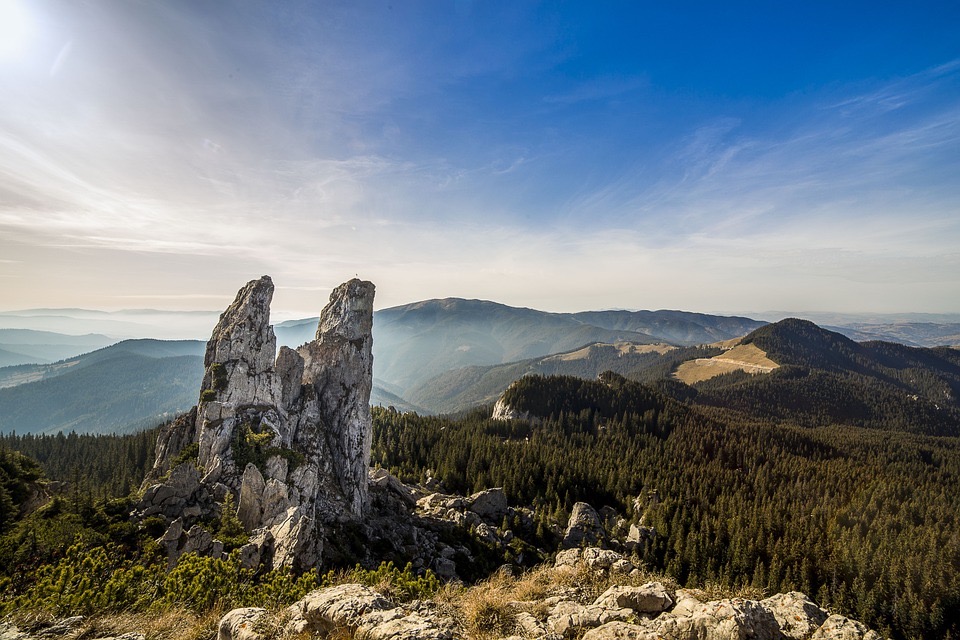
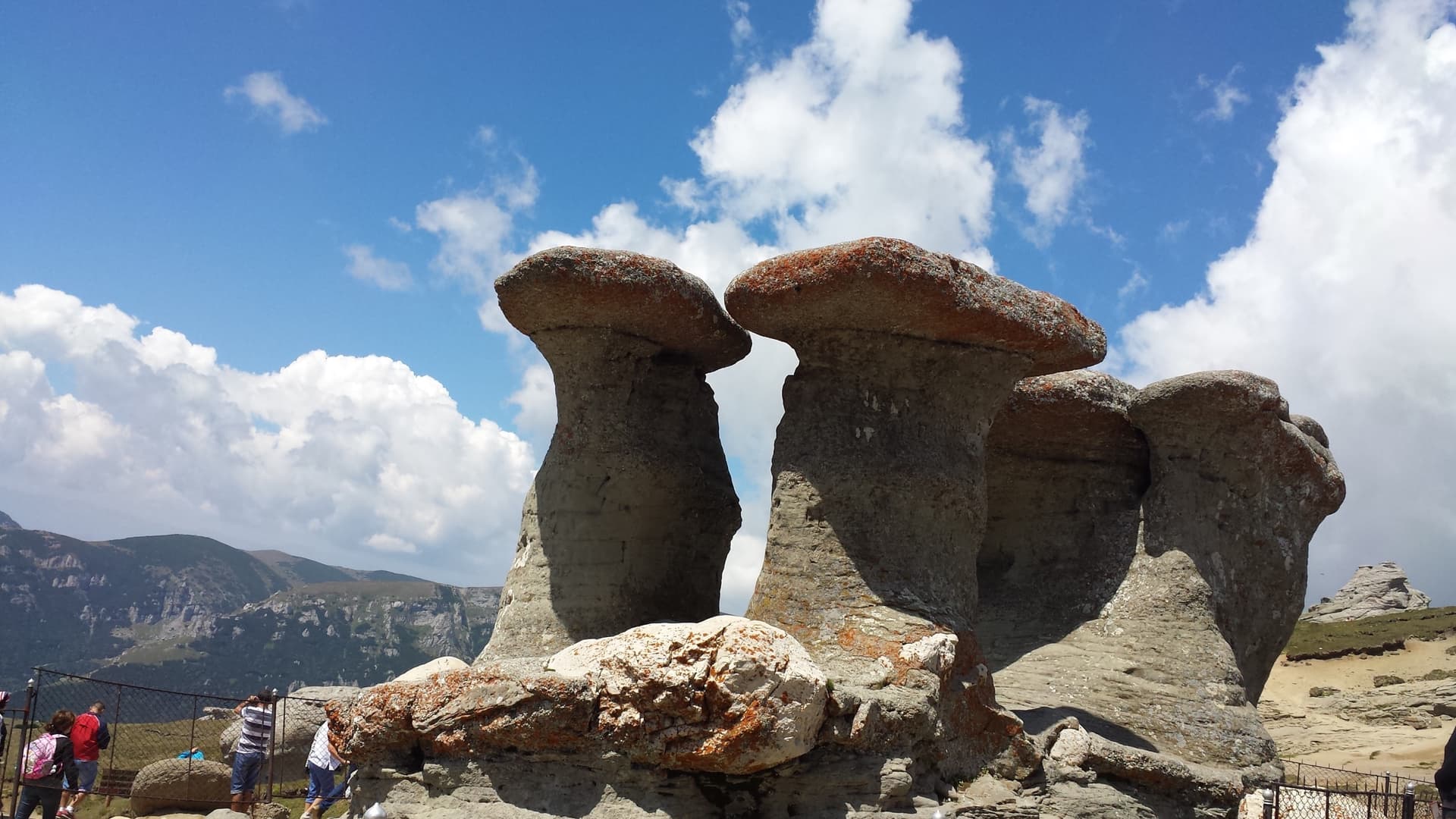
The Sphinx and the Babele are rock formations shaped by wind and glacial erosion. Made of sandstone and conglomerates, they have been sculpted over tens of thousands of years by the violent winds that sweep across the plateau and by the freeze-thaw cycles typical of high altitude. The Sphinx, a megalith roughly ten metres high, owes its name to the human profile that can be discerned from one precise angle, first documented in a photograph at the end of the 19th century. The Babele, which literally means "the old ladies" in Romanian, describe a group of mushroom-shaped rocks, the product of the same differential erosion process.
The site is associated with the Dacians, an ancient people who occupied the region before Roman conquest. According to a tradition adopted by some Romanian authors, the Dacians saw the Sphinx as a sacred place linked to their beliefs. It should be noted, however, that Dacia was conquered by Emperor Trajan in 106 AD, and modern Romanians are descended precisely from the mixture of Dacian populations and Roman settlers: Romanian culture is therefore the heir to both worlds. The Sphinx also feeds contemporary esoteric imagination that presents it as a high-energy site, a popular belief that should be taken as such.
What to see on site
The Sphinx
Isolated on the plateau, the rock rises to approximately 2,216 metres. The "human" profile is only visible from one precise angle, generally pointed out by visitors. The contrast between the massive silhouette and the empty space around it largely explains the impression the site creates.
The Babele
About ten minutes' walk from the Sphinx, the Babele form a small group of mushroom-shaped rocks, whose narrower base has been more heavily attacked by winds laden with particles. A mountain hut and shelter are found in the immediate vicinity.
The plateau and its panoramas
From the natural viewpoint, views extend over the Prahova valley, the Southern Carpathians and, further afield, the pre-Carpathians. Several marked trails leave the plateau towards the Caraiman cross, Mount Omu summit (the massif's highest point at 2,505 m) or descent to Sinaia.
When to go
The most comfortable season runs from late June to mid-September, when trails are snow-free and the cable car operates regularly. In July-August, weekends see heavy footfall and queues at Bușteni's cable car can be long: opt for early morning departures. Autumn offers interesting light but more changeable conditions. In winter, the plateau transforms into a skiing and snowshoe hiking domain, with dry cold and violent winds: high-mountain equipment is essential.
How to get there
- By cable car from Bușteni: this is the simplest access. The departure point is in central Bușteni, on National Road 1 between Brașov and Sinaia. The ascent takes about ten minutes and arrives near the Babele.
- By cable car from Sinaia: another section allows access to the plateau via Cota 1400 then Cota 2000.
- On foot: several marked trails climb from Bușteni (Jepii Mici, Jepi valley) or Sinaia. Allow 4 to 6 hours of climbing depending on the route, with significant elevation gain.
- By train: Bușteni and Sinaia are served by the Bucharest-Brașov line, allowing a day trip from Bucharest.
Practical information
- Altitude: approximately 2,200 metres; bring a windbreaker and good hiking shoes even in summer.
- Cable car fare: moderate, payable on site; budget for a round trip.
- Visit duration: 1 to 2 hours on the plateau to see the Sphinx, the Babele and enjoy the panorama, longer if you extend with a hike.
- Safety: weather changes quickly at high altitude; check conditions before heading up and stick to marked trails in case of fog.
- Dining: the Babele hut offers simple fare; in high season, waits can be lengthy.
Nearby attractions
- Bușteni and the Caraiman cross: monument erected on a nearby ridge, visible from afar.
- Sinaia and Peleș Castle: former summer residence of Romanian kings, about twenty minutes' drive away.
- Brașov: medieval Transylvanian town, approximately 30 km to the north, a convenient starting point for the rest of your journey.
- To extend the mountain itinerary, the Transfăgărășan road and the Apuseni Mountains offer other Carpathian landscapes.
- On the heritage side, Corvin Castle and Salina Turda complete a Transylvania circuit.
Frequently asked questions
Frequently asked questions
The two formations are situated on the Bucegi plateau, around 2,200 metres altitude. The Sphinx rises to approximately 2,216 metres.
No. The Bușteni cable car drops visitors just minutes' walk from the Babele, making the site accessible without particular effort. Hiking remains an option for trained walkers.
From late June to mid-September for comfortable summer conditions. Winter is possible but reserved for those equipped for high-mountain terrain.
Allow 1 to 2 hours to see both sites and enjoy the view, and half a day to a full day if you combine it with a hike on the plateau.
No. Geologists and historians agree on a purely natural origin: the form results from the erosion of sandstone and conglomerates. The "human" profile only appears from one precise angle.
Include the Bucegi in your trip
The Sphinx and the Babele fit easily into an itinerary between Bucharest, Sinaia and Brașov, in the Prahova valley. To build a stay that combines mountains, Transylvanian castles and medieval towns, consult our Romania travel suggestions.
Interested in this visit?
We can include it in your personalised itinerary.