The "Mud Volcanoes"
The "Mud Volcanoes"
Some 30 km from Buzău, the Berca mud volcanoes create a mineral landscape protected since 1924, where cold mud rises to the surface through the effect of methane.
Some thirty kilometers north of Buzău, in Romania, the Berca site presents a rare geological curiosity in Europe: cones of grey mud that ooze, bubble and overflow in slow flows across cracked earth. These "mud volcanoes" (Vulcanii Noroioși) form an unexpected mineral landscape, classified as a natural monument since 1924.
Why Visit the Berca Mud Volcanoes
- An uncommon geological phenomenon in Europe, observable up close
- A protected site for nearly a century, freely accessible
- Barren landscapes, shaped by mud and rainfall erosion
- An original stop along a route through the Buzău region, between Bucharest and Transylvania
A Site Protected Since 1924
The Berca mud volcanoes have been declared natural monuments since 1924, making them one of Romania's oldest protected reserves. The area consists mainly of two sectors, Pâclele Mari (the Great Muds) and Pâclele Mici (the Little Muds), located in Berca commune, in Buzău county.
How Mud Volcanoes Form
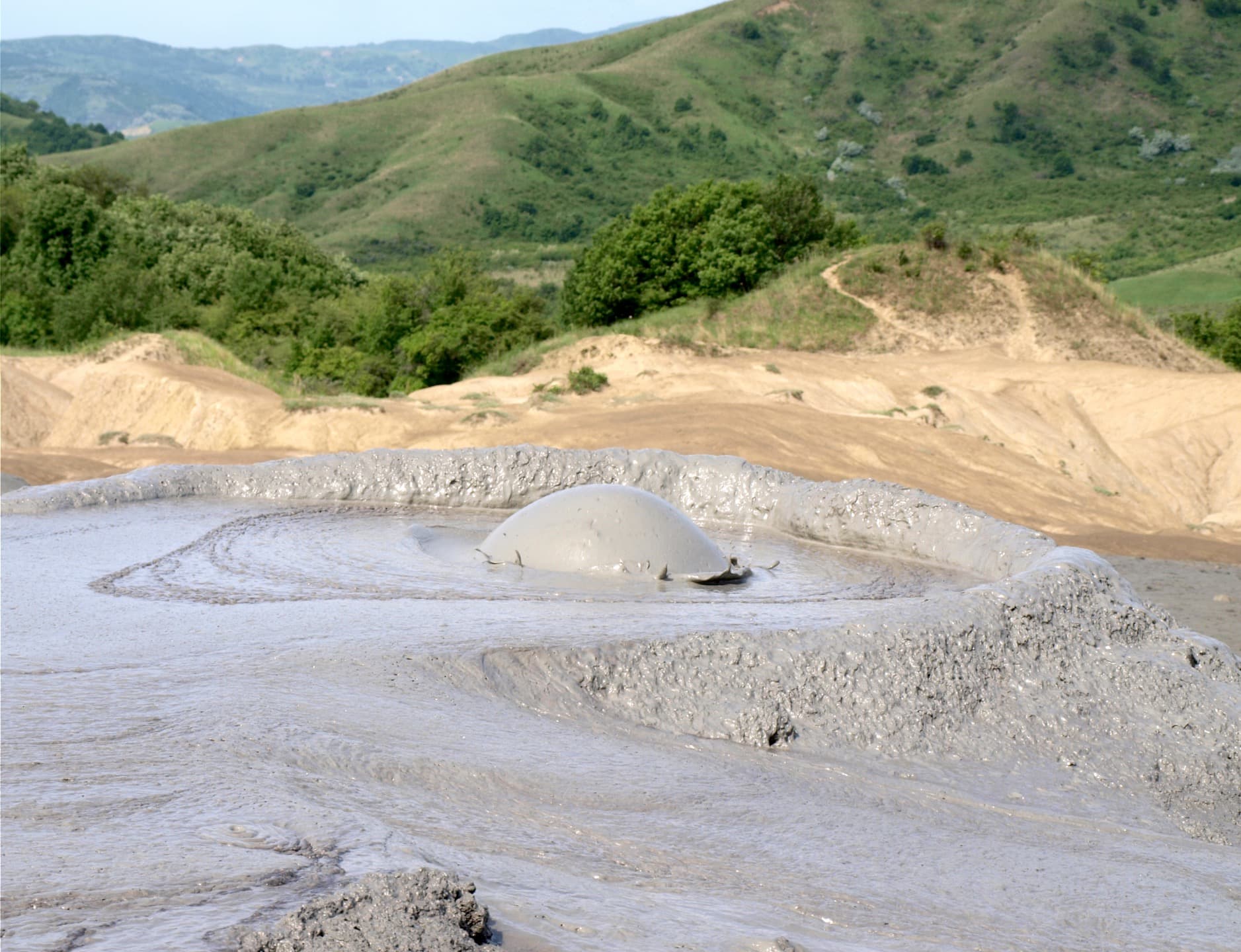
The phenomenon originates from sedimentary, not magmatic, processes. Below ground, pockets of gas, primarily methane, rise toward the surface from deep layers linked to oil deposits in the Carpathian region. As it passes through layers of wet clay, the gas carries cold mud upward. In simple terms, cold mud is pushed up from the earth by methane and accumulates around the opening to form small cones, sometimes only a few meters high.
The spectacle unfolds at the crater surface: a bubble appears in the liquid mud and bursts, slightly raising the volcano's crown. The rhythm varies from crater to crater, ranging from a few seconds to several minutes between bubbles.
What You'll Observe On Site
The Craters and Flows
The cones measure from a few dozen centimeters to several meters. Some emit very fluid mud that spreads into wide grey "rivers"; others, more paste-like, build taller and more stable structures. The mud, salty, prevents vegetation from growing nearby, which heightens the site's mineral aspect.
Terrain Sculpted by Rain
Around the craters, rains have carved forms into the sandy terrain: ravines, sharp ridges, micro-canyons. This erosional modelling, combined with grey and ochre soil tones, gives the site a surprisingly desert-like atmosphere in the heart of verdant Romania.
Adapted Fauna and Flora
A few halophytic plant species (salt-tolerant) manage to colonize the site's margins. The area is also home to small reptiles and insects, best observed without straying from the paths.
Practical Information
- Access: open site with a modest entrance fee collected upon arrival
- Duration: allow 1 to 2 hours on site to explore the main craters
- Equipment: closed-toe shoes essential (clay soil, slippery after rain), water, hat in summer
- Safety: do not approach crater edges, dried mud crust may collapse; keep children close by
- Services: few amenities on site, bring water and a snack
When to Visit
The site is theoretically accessible year-round, but weather heavily influences the experience. The most favorable periods run from spring through autumn, when the dirt paths leading to the craters are passable.
- Spring (April-June): surrounding vegetation still green, striking contrast with grey soil
- Summer (July-August): dry, cracked soil, desert-like atmosphere, but intense midday heat
- Autumn (September-October): soft light, quieter crowds
- Winter and heavy rain: access track often muddy and barely passable, best avoided
How to Get There
The mud volcanoes lie roughly 30 km north of Buzău, the nearest city with train stations and services. From Buzău, follow the road toward Berca then signs for "Vulcanii Noroioși" toward Pâclele Mari or Pâclele Mici.
- By car: the most practical option; the final kilometers are on a narrow road, sometimes in poor condition
- From Bucharest: roughly 2.5 hours by road via A3 motorway then DN2
- From Brașov: roughly 2.5 hours via DN10 through the Carpathians
- Public transport: not well-suited; arrange a taxi or private transfer from Buzău
To Combine in the Region
The Buzău region remains off the beaten path for foreign travelers, yet the site integrates well into a broader Romanian itinerary. The Carpathians and Transylvania are within reach, with several notable stops:
- The Transfăgărășan road, a spectacular crossing of the southern Carpathians
- Corvin Castle in Hunedoara, the country's major Gothic fortress
- The Salina Turda salt mine, another Romanian underground curiosity
- The Danube Delta Museum in Tulcea, to extend eastward
Frequently Asked Questions
Frequently asked questions
The mud is cold and the phenomenon has nothing eruptive about it in the magmatic sense. The main risk comes from the dried crust around the craters, which may give way under weight. Stay on the paths and keep children at distance from the edges.
One to two hours are sufficient to explore one sector (Pâclele Mari or Pâclele Mici). Allow more time if you wish to see both sites, separated by a few kilometers.
Yes, the site is highly visual and often fascinates children. Constant supervision remains necessary due to open craters and sometimes slippery ground.
The mud is salty and mineral-rich, but the site is protected: collection is prohibited. No therapeutic use is organized on site.
Theoretically yes, but the access track often becomes impassable after heavy rain or snow. Favor the April to October period.
Incorporating Berca into Your Romania Trip
The mud volcanoes offer an original stop between Bucharest and Transylvania, to combine with other major sites in the country. To build a tailor-made itinerary including this geological curiosity, consult our Romania travel suggestions.
Interested in this visit?
We can include it in your personalised itinerary.