Sucevita Monastery
Sucevita Monastery
The last of Bukovina's painted monasteries, Sucevita is UNESCO-listed. Its 16th-century exterior frescoes rank among Moldavia's best-preserved.
Inscribed as a UNESCO World Heritage site in 2010 as part of the "Churches of Moldavia" ensemble, Sucevita Monastery stands in a valley in northern Bukovina, Roumanie. Its exterior frescoes, dominated by a deep green, make it one of the last and most accomplished of the 16th-century painted Moldavian monasteries.
Why visit Sucevita Monastery
Sucevita is often perceived as the "testament of Moldavian art": it closes the great series of painted Bukovina monasteries begun a century earlier at Voroneț or Humor. Its exterior frescoes rank among the best-preserved and most numerous of Moldavia's painted monasteries, allowing visitors to grasp an iconographic program of rare completeness.
The site's appeal rests on several distinctive features:
- a fortified enclosure still standing, with four corner towers and a walkway, which reflects the building's defensive function;
- near-complete exterior wall decoration, except for one wall that remained white;
- a unique fresco among the painted monasteries, the "Ladder of Virtues";
- a preserved rural setting, away from major tourist routes.
History of the monastery
Sucevita was built in the late 16th century under the impetus of the Movilă family, a lineage of high Moldavian dignitaries who would give several princes to Moldavia and Wallachia. The main church, dedicated to the Resurrection of Christ, was consecrated around 1585, then adorned with interior and exterior frescoes in the years that followed.
Unlike most of Bukovina's painted monasteries, which are earlier princely foundations, Sucevita is a commission by boyars, evident in the richness of decoration and the presence of donor portraits. The complex also served as a refuge during troubled times, hence its powerful walls.
A local legend circulates regarding the northern wall, which remained bare: according to oral tradition, the painter commissioned to decorate it fell from the scaffolding and died, leaving this side of the church undecorated. The tale, whose historical accuracy cannot be verified, is today an integral part of the visit.
What to see on site
The exterior frescoes
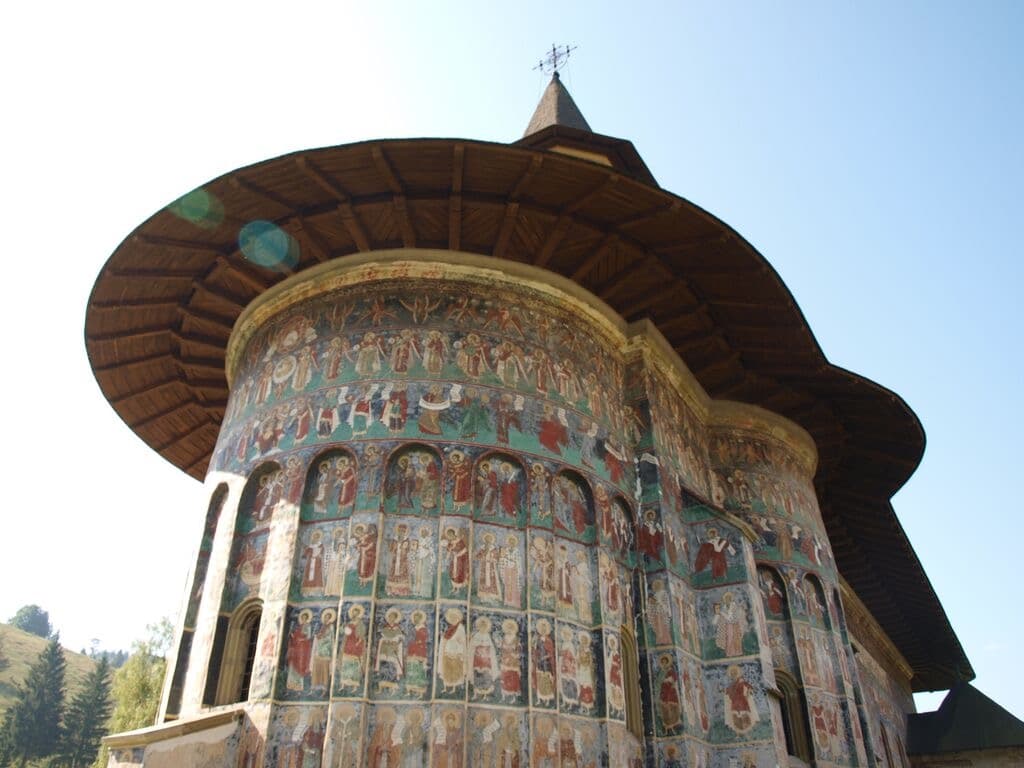
The painted program covers nearly all facades of the church. The dark green background, characteristic of Sucevita, serves as a canvas for hundreds of scenes: prophets, military saints, biblical genealogies, scenes from the life of the Virgin. The south wall is devoted to a densely populated "Tree of Jesse", framed by a procession of ancient philosophers considered as harbingers of Christianity.
The Ladder of Virtues
Sucevita is the only painted monastery in Bukovina to feature the "Ladder of Virtues", inspired by the treatise of John Climacus. The fresco depicts a ladder with thirty rungs that monks must climb to reach paradise, while demons attempt to make them fall. The composition, highly legible, occupies the north facade and is one of the highlights of the visit.
The interior of the church
The interior, darker, preserves complete painted decoration: the nave, narthex, tomb chamber, and altar are entirely covered with frescoes. The portraits of Movilă founders holding the church model can be seen here, as well as their tombs.
The enclosure and museum
The convent buildings house a small museum presenting manuscripts, embroideries, and liturgical objects related to the Movilă family. Walking along the rampart walk allows visitors to understand the dual monastic and defensive function of the site.
Practical information
- Location: village of Sucevita, Suceava county (județ), in northern Bukovina.
- Duration of visit: allow 1 to 1.5 hours for a complete tour (church, museum, enclosure).
- Entrance fee: modest entry fee, possible supplement for photography.
- Dress code: shoulders and knees covered, the site remains an active monastery occupied by a monastic community.
- Languages: explanatory signs in Romanian, brochures in English and French available at the reception.
When to go
The most favorable period extends from May to October, when light brings out the pigments of the frescoes and Bukovina's roads are easily passable. July and August concentrate the majority of visitors; spring and early autumn offer quieter crowds and colorful landscapes. In winter, the site remains open but access conditions depend on snowfall.
How to get there
Sucevita is located approximately 50 km west of Suceava, the region's main city and gateway to Bukovina. Suceava is served by a regional airport, by train from Bucharest, and by national bus lines.
From Suceava, Sucevita is reached by car via national roads DN2 then DN17A, in approximately 1 hour 15 minutes. A car (or private transfer) remains the most practical way to combine Sucevita with the other painted monasteries — Moldovita, Voroneț, Humor, Putna — which form a coherent circuit across Bukovina.
What to see in the region
A visit to Sucevita naturally fits into a broader itinerary across northern Roumanie. Within a few hours' drive, several sites extend the discovery of rural and religious heritage:
- the wooden churches of Ieud, in neighboring Maramureș, listed by UNESCO;
- the Museum of the Romanian Peasant at Dragomirești, dedicated to traditional rural life;
- the geological reserve "Creasta Cocoșului", for a nature stop in the Gutâi mountains;
- the ASTRA Ethnographic Museum, in Sibiu, further south, which complements understanding of Romanian rural cultures.
Frequently asked questions
Yes. Sucevita is inscribed as a UNESCO World Heritage site as part of the Churches of Moldavia ensemble, which brings together the main painted monasteries of Bukovina.
Local legend claims that the painter commissioned to decorate this wall fell from the scaffolding and died, leaving the facade undecorated. No historical source confirms the episode, but it remains part of the site's oral memory.
It is a fresco inspired by the treatise of John Climacus, depicting monks climbing a ladder with thirty rungs toward paradise while demons attempt to make them fall. Sucevita is the unique painted monastery of Bukovina to have incorporated it into its exterior decoration.
One to one and a half hours are sufficient to tour the exterior frescoes, visit the church and small museum. Allow more time if you wish to extend with a walk through the village.
Prepare your trip
Sucevita combines ideally with the other painted monasteries, Maramureș, and the Suceava region within an 8 to 12-day itinerary. To build a customized program, consult our Roumanie travel suggestions.
Nearby
Interested in this visit?
We can include it in your personalised itinerary.