Iron Gates Natural Park
Iron Gates Natural Park
In southwestern Romania, Iron Gates Natural Park protects the Danube gorges, its limestone cliffs, and a unique Dacian, Roman, and religious heritage.
Iron Gates Natural Park is a protected area of national interest located in southwestern Romania, with its southern boundary being the Romanian bank of the Danube. Spanning over 115,000 hectares, it is one of the country's largest natural parks. Here, the Danube cuts through the Carpathians in a succession of spectacular gorges, where the river, compressed between limestone walls, winds for nearly 130 kilometers between Romania and Serbia.
Why visit Iron Gates Natural Park
The park combines several interests rarely found in one place: remarkable geological heritage with the Danube gorges, protected biodiversity under the Natura 2000 network, and human traces spanning more than two millennia, from the Dacians and Romans to contemporary villages. It is also one of the rare places in Romania where you can witness the Danube in its most impressive form, enclosed between vertical cliffs.
- Gorge landscapes between Orșova and the Serbian border
- Danube cruises through the heart of Cazanele Dunării
- Protected fauna and flora (birds of prey, bats, endemic species)
- Historical and religious sites dotted along the river
A bit of history
The Iron Gates region has always been a strategic lock on the Danube. The Romans, under Emperor Trajan, had a monumental bridge built here in the early 2nd century, designed by architect Apollodorus of Damascus, along with a road carved into the cliff to move their legions toward Dacia. The famous Tabula Traiana, a Roman inscription engraved in rock, is still visible on the Serbian side.
In the 20th century, construction of the Iron Gates I hydroelectric dam, completed in 1972 as part of a joint Romanian-Yugoslav project, profoundly altered the river's course. When the reservoir filled, Ada Kaleh island was submerged, its Turkish inhabitants were displaced, and several villages disappeared under the waters. The current natural park was officially created in 2003 to protect what remained of this balance between river, mountain, and heritage.
What to see in the park
The Cazanele Dunării
« Cazanele Dunării » (the Danube cauldrons) are a section of the Danube Gorges as the river passes through the Carpathians. They measure approximately 9 km long and present maximum depths of around 75 m. In some places, the Danube narrows to just 230 m, making navigation difficult as the river is bordered by vertical rock walls. There are the Great Cauldrons (Cazanele Mari) and Small Cauldrons (Cazanele Mici), accessible mainly by boat.
The Decebal statue
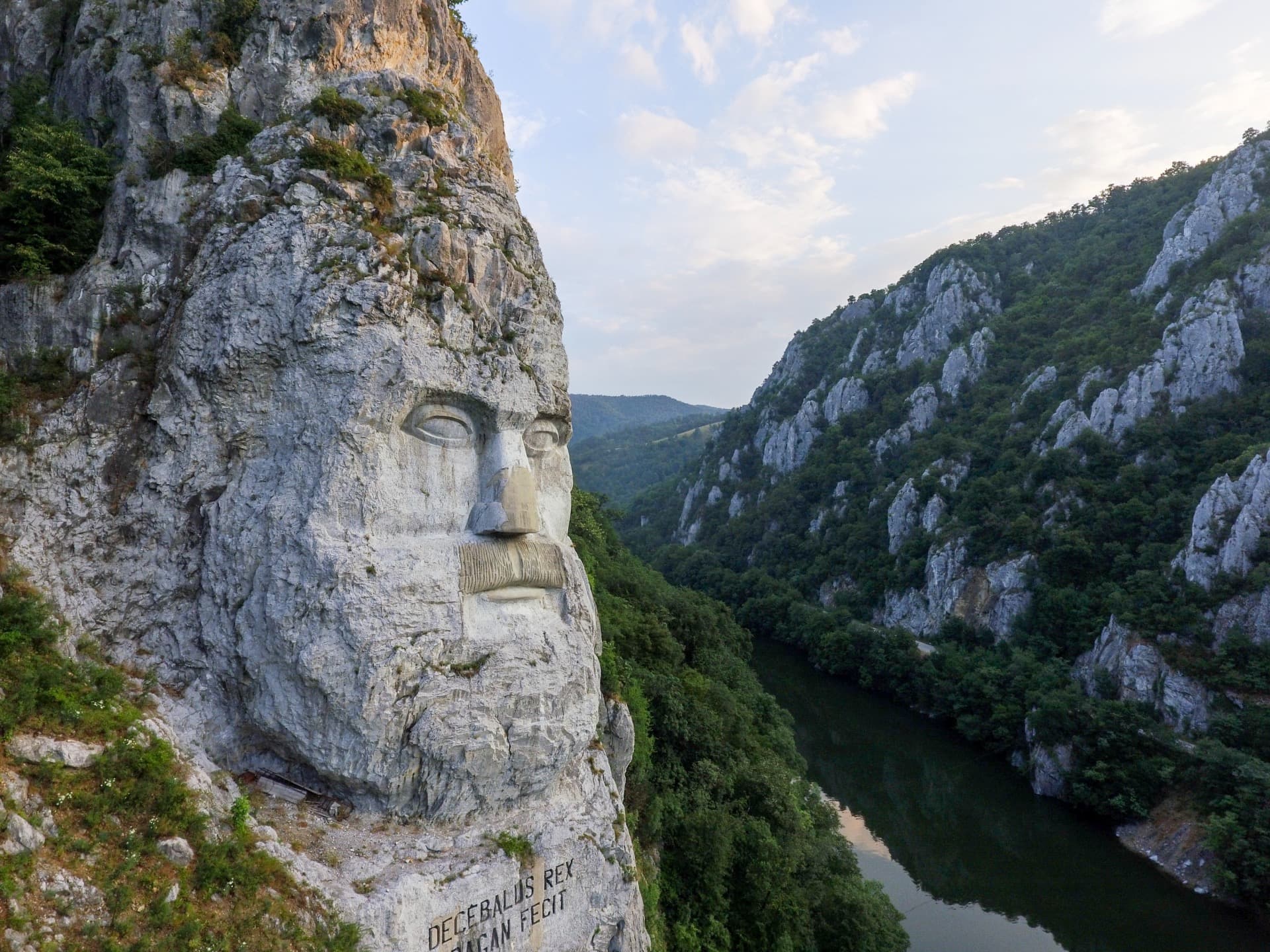
Carved directly into the cliff between 1994 and 2004, this monumental effigy of the last Dacian king stands 55 meters high, making it Europe's largest rock sculpture. It rises facing the remains of the Tabula Traiana, in a geopolitical staging that is far from neutral.
Mraconia Monastery
Rebuilt after being submerged by the dam's filling, Mraconia Monastery now reflects in the calm waters of the Danube, in close proximity to the Decebal statue. It is a popular stop on boat excursions.
Ponicova Cave and other natural curiosities
The largest cave in the gorge, Ponicova opens directly onto the Danube and shelters several bat colonies. The park also features scenic viewpoints (Ciucaru Mare, Ciucaru Mic) accessible on foot from the DN57 road.
When to visit
From May to October, conditions are most favorable: navigation is possible, trails are passable, and temperatures are mild. Spring and early autumn offer particularly beautiful light on the cliffs and avoid the heavy heat of July-August. In winter, some sections remain accessible by car, but cruises are generally suspended.
Practical information
- Duration of visit: plan for a minimum of one day for the gorge section, two to three days to explore the park thoroughly
- Cruises: departures from Orșova, Eșelnița, or Dubova, with moderate prices depending on duration
- Hiking: marked trails starting from Dubova and Svinița, bring closed-toe shoes and water
- Accommodation: guesthouses and small hotels concentrated in Orșova and riverside villages
How to get there
The most convenient gateway is the town of Orșova, approximately 1.5 hours from Drobeta-Turnu Severin and 4-5 hours' drive from Timișoara or Bucharest. The DN57 national road runs alongside the Danube throughout the park's crossing, all the way to the Serbian border. From Bucharest, you can also reach Drobeta-Turnu Severin by train, then continue by bus or rental car.
Other sites to see in the region
Romania has other natural and heritage sites that complement a visit to Iron Gates well:
- The Creasta Cocoșului geological reserve, in Maramureș
- Enisala Fortress, near the Black Sea
- The ASTRA Ethnographic Museum in Sibiu
- The wooden churches of Ieud
Frequently asked questions
Plan your trip
Iron Gates Natural Park fits naturally into an itinerary covering southwestern Romania and Transylvania. To build a custom trip, consult our Romania travel suggestions.
Interested in this visit?
We can include it in your personalised itinerary.