Curtea de Arges Monastery
Curtea de Arges Monastery
Necropolis of the Kings of Romania and a sculptural masterpiece of the 16th century, Curtea de Arges Monastery blends architecture, royal memory, and legend.
Curtea de Arges Monastery is one of the most singular religious buildings in Romania. Built in the early 16th century in the former capital of Wallachia, it houses the necropolis of the Kings of Romania and displays ornamental architecture unique in Eastern Europe, a blend of Byzantine, Georgian, and Oriental influences.
Why visit Curtea de Arges Monastery
The site condenses several layers of Romanian history. Curtea de Arges, founded in the 14th century, was one of Wallachia's capitals: the ruins of the Princely Court that gave the city its name can still be found here. The word "curtea" designates a prince's residence, hence the name Curtea de Arges.
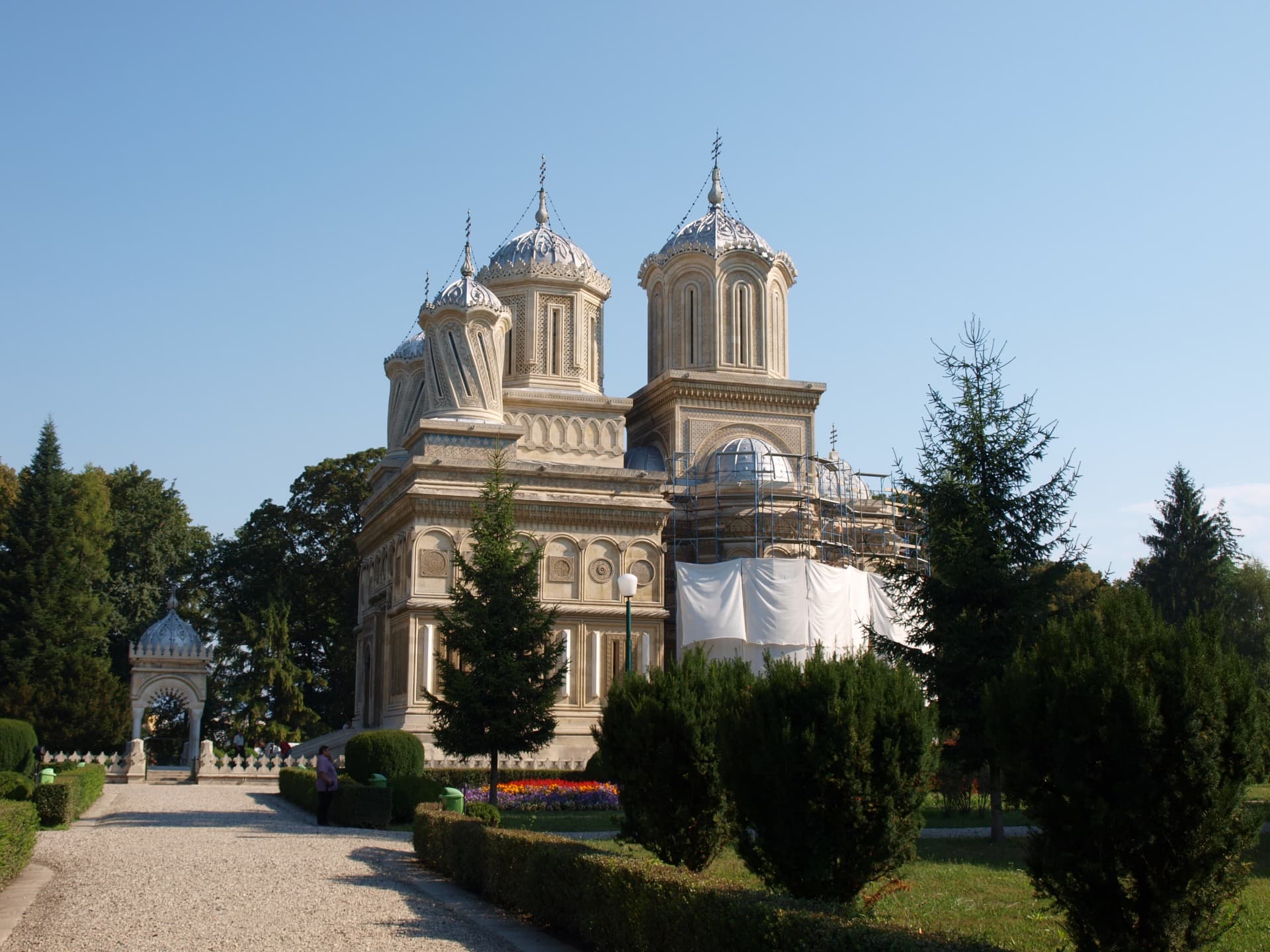
The monastery church, commissioned by voivode Neagoe Basarab, strikes with its façade sculpted like stone lace, its twisted columns, and floral motifs carved directly into limestone. Inside rest modern Romanian sovereigns—Carol I, Ferdinand I, Carol II, and Michael I—making it a place of national memory as much as an Orthodox sanctuary.
History and the legend of Master Manole
The monastery was built in the early 16th century (circa 1512–1517) by voivode Neagoe Basarab, a Wallachian ruler known for his cultural refinement and exchanges with Mount Athos. The building follows older constructions linked to the princely court established here in the 14th century.
A famous legend, transmitted through the popular ballad Monastirea Argesului, tells the story of Master Manole, the architect in charge of the construction site. According to the tale, the walls collapsed every night. To ward off the curse, Manole allegedly had his own wife Ana immured in the masonry. Once the work was completed, the voivode supposedly had the scaffolding removed to prevent the builders from creating a similar structure elsewhere; Manole threw himself from the roof, and where he touched the ground a spring emerged that still flows near the monastery. This legend, one of the most famous in Romanian folklore, is studied in Romania as a founding myth of artistic creation.
In the late 19th century, French architect André Lecomte du Noüy undertook extensive restoration. The monastery became a royal necropolis after Carol I's coronation as the first king of modern Romania in 1881.
What to see on site
The Episcopal Church
The heart of the complex, the trefoil-plan church surprises with its compact proportions and extremely elaborate exterior décor. Scholars recognize Armenian, Georgian, and Islamic influences (rosette motifs, interlacing, stylized inscriptions) integrated into the post-Byzantine tradition. The four towers, two of which are twisted in opposite directions, have become a Romanian architectural symbol.
The Royal Tombs
The interior, frescoed during 19th-century restoration, houses the marble sarcophagi of the kings and queens of Romania. This is where King Michael I, the country's last sovereign, was buried in 2017.
The Manole Fountain
A short distance from the enclosure, a small spring recalls the legend of the architect. A spot where visitors enjoy a pause, it complements the cultural visit with a folkloric dimension.
The park and monastic enclosure
The monastery is surrounded by well-maintained gardens, convent buildings, and an attached chapel. Monastic life remains active here, which requires appropriate dress (shoulders and knees covered, headscarf for women inside the church).
Practical Information
- Visit duration: Allow 1 to 1.5 hours for the monastery and its surroundings; longer if combining with the Princely Court ruins in town.
- Entry fee: Modest entrance fee; a contribution is expected for photography inside the church.
- Hours: Open daily, with extended hours during the summer season. Liturgical services may restrict access to the choir.
- Dress code: Orthodox dress code is enforced at the entrance.
- Best time to visit: May through October to enjoy the gardens and light on the sculpted stone.
How to get there
Curtea de Arges is located in the southern Carpathians, approximately 150 km northwest of Bucharest and 35 km from Pitesti. From Bucharest, allow 2.5 to 3 hours by car via the A1 motorway and then the DN7C. Trains and buses regularly connect Pitesti to Curtea de Arges.
The city also serves as the southern starting point of the country's most spectacular alpine route, making it a logical stop for itineraries through Transylvania or toward Wallachian castles.
What to see nearby
- The Transfăgărășan Road: the north-south traverse of the Carpathians begins a few kilometers north of Curtea de Arges, with dams, glacial lakes, and passes over 2,000 meters.
- Corvin Castle: a major Gothic fortress in Transylvania, accessible by extending the route westward.
- ASTRA Ethnographic Museum in Sibiu, to understand Romanian vernacular architecture after seeing its learned masterpiece.
- Salina Turda: a salt mine transformed into a spectacular underground site, to combine on a Transylvanian circuit.
Preparing your trip
Curtea de Arges Monastery integrates naturally into an itinerary combining Wallachia, the Carpathians, and Transylvania. To build a tailor-made route including this site, consult our Romania travel ideas.
Interested in this visit?
We can include it in your personalised itinerary.