Ceahlău Mountains
Ceahlău Mountains
National park in the Eastern Carpathians, the Ceahlău massif brings together rocky peaks, pristine forests and the famous legend of Dochia.
The Ceahlău massif, located in northeastern Romania in the heart of the Eastern Carpathians, is home to one of the country's most emblematic national parks. A protected area of national interest, Ceahlău National Park extends over more than 7,000 hectares of forests, plateaus and rocky peaks, and concentrates a significant portion of Carpathian wildlife. The mountain also holds a singular place in Romanian imagination: its rock formations have inspired legends and traditions, including that of old Dochia, still told today.
Why visit Ceahlău Mountains
Ceahlău brings together what mountainous Romania has to offer at its most representative: preserved Carpathian nature, dense spiritual heritage (the massif is dotted with hermitages and monasteries), and a mineral landscape that has shaped popular narratives passed down through generations. The park's forests welcome the majority of the Carpathians' large mammals—brown bear, wolf, lynx, deer, chamois—as well as rich birdlife.
For those seeking to understand Romania beyond its cities, Ceahlău is a substantial waypoint, at once ecological, cultural and spiritual.
What to see in the massif
Peaks and rock formations
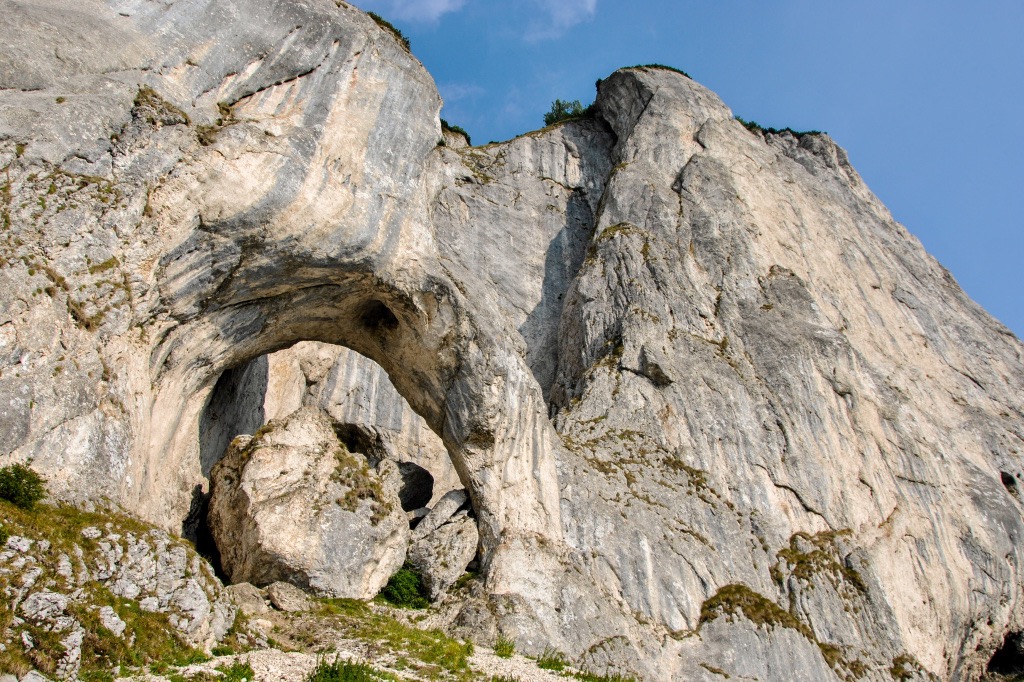
Erosion has sculpted remarkable silhouettes in limestone and conglomerate, each associated with a legend:
- Toaca peak (1,904 m): one of the massif's best-known summits, prized for its sunrise panoramas.
- Detunatele, or "Thunder Rocks": a mineral alignment marked by lightning and stormy weather.
- Panaghia rock: an isolated form charged with religious symbolism.
- Dochia rock: an assumed human silhouette, at the heart of the massif's most famous legend.
Monastic heritage
Since the Middle Ages, Ceahlău has been a land of hermits. Several small hermitages and the Durău monastery, at the foot of the massif, bear witness to this ancient presence and remain accessible to visitors.
The legend of Dochia
According to tradition, the massif takes its name from the bearded vulture, a bird of prey that is said to have once haunted the place—a legendary rather than zoological account, as the species is not documented in the region.
The best-known story is that of Dochia. On the first day of March, this old woman made life difficult for her daughter-in-law, imposing multiple tasks: washing clothes at the river, dyeing garments, preparing meals, cleaning the house, gathering fruit in the forest. God, moved to compassion, took the appearance of an old man to help the young woman. Meanwhile, Dochia went for a walk in the mountains with her goats, covered in nine furs. To punish her for her cruelty, God sent pouring rain. Dochia removed her furs, now heavy with water. An icy wind then rose and transformed her and her goats into blocks of ice, which later became rock.
This legend gave rise to a still-living regional tradition: the first nine days of March are called "the days of the old women". Each woman chooses her day; if the weather is fair, the year will be favorable to her; if it rains, the sign is less auspicious.
When to go
The massif is visited in two very different seasons:
- June to September: the ideal period for hiking. Main trails are clear, mountain huts are open, and temperatures at altitude remain pleasant.
- December to March: abundant snow, spectacular landscapes, but demanding conditions. Winter hiking requires equipment and experience.
- April-May and October-November: shoulder seasons with unstable weather, low crowds, but trails sometimes closed or snow-covered.
March 1st, the symbolic beginning of the "Days of Dochia," remains a particular moment in local culture.
Practical information
- Duration of visit: allow a full day for a hiking loop to the summit plateau, two days with overnight refuge stay to explore more thoroughly.
- Level: marked trails but sustained elevation gain (800 to 1,300 m depending on routes); good physical fitness recommended.
- Equipment: mountain boots, rain gear, water and snacks; weather changes quickly at altitude.
- Accommodation: mountain huts on the plateau (Cabana Dochia notably) and guesthouses in Durău and Izvoru Muntelui.
- Paid access: the national park charges a modest entry fee, payable at ranger posts.
How to get there
The massif is located in Neamț County. The two main starting points for hiking are:
- Durău, on the western slope, accessible from Piatra Neamț (approximately 1.5 hours by road).
- Izvoru Muntelui, on the eastern slope, near Lake Bicaz.
The nearest airport is Iași (approximately 3 hours by road). From Bucharest, allow 6 to 7 hours by car. Public transport to the villages at the foot of the massif exists but remains infrequent: a car significantly facilitates logistics.
What to see in the region
Ceahlău combines well with other Romanian stops:
- Bârsana Monastery, in Maramureș, to continue exploring wooden religious heritage.
- Transfăgărășan Road, another major Carpathian crossing, on the southern slope.
- Salina Turda, a former salt mine converted into an attraction, accessible by heading toward Transylvania.
- Danube Delta Museum, to complete the natural picture of the country.
Frequently asked questions
Frequently asked questions
No, but good physical fitness is necessary. Trails are marked; the elevation gain remains significant and weather at altitude can change rapidly.
Yes. Several mountain huts welcome hikers on the summit plateau, including Cabana Dochia. Booking is advised during peak season.
Yes, but only to equipped and experienced hikers. Snow can be abundant and some trails become technical.
Yes, a modest fee is charged at the entrance to the national park, usually at ranger posts.
June to September for standard hiking. Winter offers remarkable landscapes but requires serious preparation.
Including Ceahlău in a trip to Romania
The massif fits naturally into an itinerary that combines the Eastern Carpathians, Bucovina and Maramureș. To build a coherent stay around Romanian nature and heritage, consult our trips to Romania.
Interested in this visit?
We can include it in your personalised itinerary.